
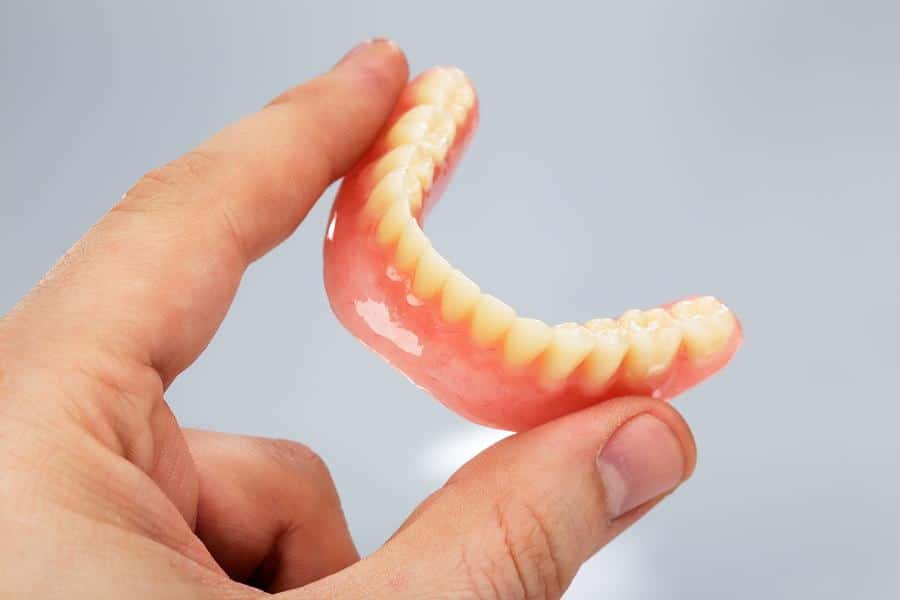
You are missing several teeth. Someone mentioned the Canadian Dental Care Plan. The question that matters is simple: will it pay for your denture?
Yes, CDCP covers dentures for eligible patients. How much it pays depends on your family income and which type of denture you need. Full and partial dentures both qualify. CDCP replaces them on a set schedule. Implant-supported dentures do not qualify at any income level. Dr. Matthew Rykiss, DDS, has practiced dentistry in Winnipeg for more than a decade. His front desk answers these income-tier and coverage questions from CDCP-eligible denture patients almost every week.
Crestwood Dental’s denture options include full dentures, immediate full dentures, and partial dentures. The clinic fits these for patients who lost teeth to disease, injury, or ongoing oral health problems. This is a question the practice answers often, and the answer changes based on your own income and denture type.
What to know before you book
- CDCP pays 100 percent of its set fee for a denture if your adjusted family net income sits under $70,000.
- That drops to 60 percent between $70,000 and $79,999, and to 40 percent between $80,000 and $89,999.
- CDCP covers one complete denture per arch on a multi-year cycle. Partial dentures follow a shorter cycle and usually need advance approval first.
- Implant-supported dentures do not qualify for CDCP at any income tier.
- Bring your CDCP welcome letter and a government photo ID to your first denture appointment.
How much does CDCP actually pay toward a denture?
CDCP reimbursement runs on three income tiers. Your household’s tier decides the whole conversation. Under $70,000 in adjusted family net income, CDCP covers 100 percent of its own set fee for a covered denture. Between $70,000 and $79,999, that drops to 60 percent. Between $80,000 and $89,999, it drops again to 40 percent. Above $90,000, a household does not qualify for CDCP at all.
Those percentages apply against CDCP’s own fee schedule. They do not apply against whatever a dentist actually charges. Picture a denture that carries a $1,000 fee on CDCP’s own fee schedule. At the 100 percent tier, CDCP pays the full $1,000. At the 60 percent tier, it pays $600 and the patient owes $400. At the 40 percent tier, it pays $400 and the patient owes $600. If a clinic’s own fee runs higher than the CDCP grid, the patient pays that gap too, on top of the tier percentage.
You must also qualify on paper, not just on income. You and your spouse or common-law partner, if you have one, both need to have filed a Canadian tax return for the most recent year. You must be a Canadian resident for tax purposes too. Skip your tax filing, and your CDCP eligibility can lapse at the next renewal, even if your income would otherwise qualify.
These figures shift as federal budgets change. Confirm your current tier at canada.ca/dental before you book, since a clinic cannot set your reimbursement rate for you. Crestwood Dental’s CDCP page lists the same eligibility criteria the front desk uses whenever a new denture patient calls to ask whether they qualify.
How often does CDCP replace a full denture versus a partial one?
CDCP treats full dentures and partial dentures as separate benefits with separate replacement schedules. A complete denture replaces an entire upper or lower arch. CDCP generally covers one per arch on a multi-year cycle, not every visit. If you already have a complete denture from a few years back, check your own renewal date first. Do not assume a new one is due.
A partial denture fills in gaps around teeth you still have. It follows a shorter replacement interval than a complete denture. It also typically needs advance approval before CDCP confirms coverage.
CDCP bills relines and repairs as separate services from a full replacement, on their own shorter schedule. If your current denture is cracked, loose, or simply worn out, ask whether a repair or reline solves the problem first. You may not need to start over with a brand-new denture. A reline is also a much smaller claim against your CDCP benefit than a full remake.
Does CDCP cover implant-supported dentures?
No, and this is the exclusion that surprises patients most. CDCP covers conventional removable dentures, but it draws a hard line at anything that relies on a dental implant for retention. An overdenture that snaps onto implant posts falls outside CDCP’s covered services. So does any denture stabilized by implants rather than by the gum and remaining teeth. Unlike the income rule, there is no partial exception here. The exclusion applies at every tier, including the 100 percent tier. No amount of paperwork changes that.
Some patients still have enough healthy tooth structure and bone for an implant post. For them, it is worth asking whether you’re a candidate for dental implants instead. Implants solve the same missing-teeth problem in a way CDCP cannot help fund. Dr. Rykiss can evaluate that option at a denture consultation, before a denture is made and before you spend CDCP dollars on a benefit you might not need.
What Crestwood Dental’s Manitoba fee guide policy means for your bill
Crestwood Dental follows the Manitoba Dental Association’s suggested fee guide for pricing. It does not adopt the federal CDCP fee schedule as its baseline. The practice says this is a deliberate choice. It keeps care the same for every patient, whether they carry CDCP, private insurance, or neither.
In practical terms, a CDCP-eligible patient at the 100 percent tier may still owe a balance. That happens if the Manitoba fee guide sits above the CDCP grid for a given procedure. CDCP only pays against its own grid, no matter what a clinic charges. This is not a hidden fee, and it is not specific to Crestwood. Any clinic billing above the CDCP grid works the same way.
Crestwood offers assignment of dental benefits whenever a plan allows it. The practice bills CDCP directly and collects only the remaining balance at the appointment. Patients do not pay in full and then wait for reimbursement later.
Front desk staff walk through your expected balance before treatment starts. They use the actual fee guide difference for your specific denture, not a rough estimate pulled after the fact once the lab work is already done.
What should you bring to your first CDCP denture appointment?
Book your first visit with your CDCP welcome letter or confirmation number in hand. Bring a government-issued photo ID too. Crestwood Dental’s team confirms your income tier and CDCP status before your exam. Then staff explain, in writing, what CDCP will likely cover and what balance you can expect to pay under the Manitoba fee guide, before any lab work begins.
Dr. Rykiss’s own background at Crestwood Dental includes ten years of fielding this exact income-tier and fee-guide question. He hears it from denture patients at the Portage Avenue office in the Crestview Strip Mall every week. A first visit rarely starts from zero. Most patients leave with a clear dollar figure, not a guess.
If you are unsure whether your missing teeth call for a full denture, a partial denture, or something else entirely, that is exactly the conversation Dr. Rykiss has with new denture patients. Call Crestwood Dental at 204-896-5888, or use the online request form, to book a CDCP denture consultation. Bring your questions about income tiers and out-of-pocket costs along with you.
